
What Is Ibrutinib?
Ibrutinib is an oral targeted kinase inhibitor used in defined hematologic and immune-mediated conditions. Its central molecular target is BTK, a signaling protein involved in B-cell receptor pathways. By covalently inhibiting BTK, ibrutinib disrupts signals that can support B-cell survival, activation, adhesion, and migration. This makes it an important example of a targeted therapy designed around a disease-relevant molecular pathway.
Mechanism of Action
In the United States, current labeling includes adult CLL/SLL, CLL/SLL with 17p deletion, WM, and cGVHD after failure of one or more systemic therapies. In the European Union, Imbruvica is authorized in defined settings for CLL, MCL, and WM. These indications are not interchangeable across countries, so a medicine website should always state the jurisdiction when presenting regulatory claims.
Diseases and Treatment Settings
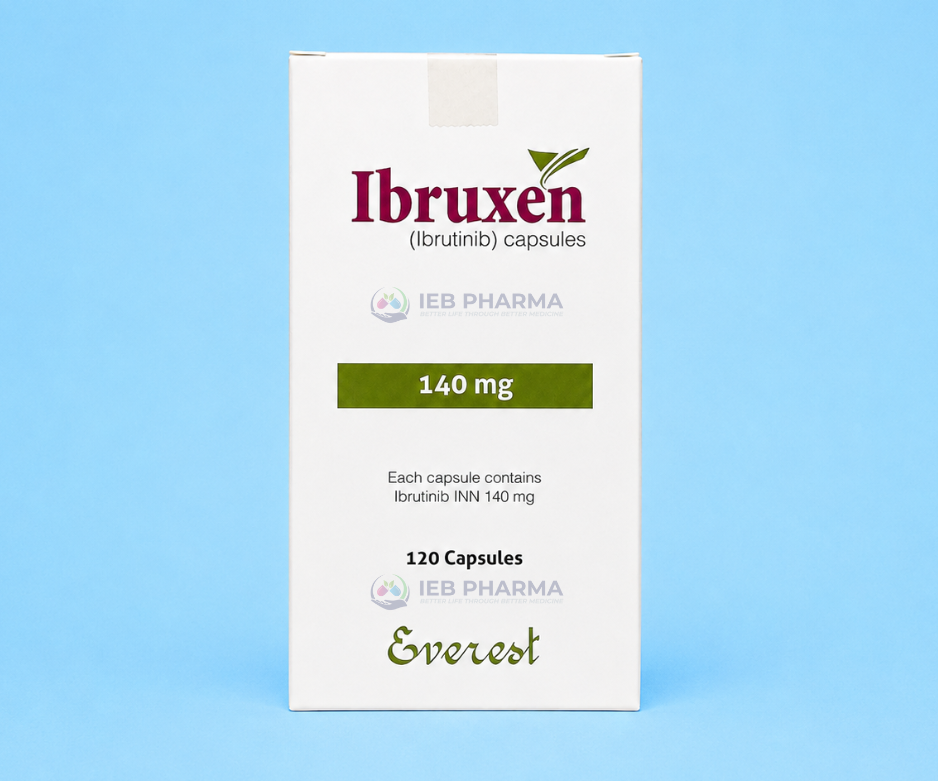
The 140 mg strength is particularly relevant to this site. Current U.S. labeling lists 140 mg capsules and 140 mg tablets among the available dosage forms. The supplied website product list identifies Ibruxen 140 mg from Everest and Ibrucent 140 mg from Incepta. Those product listings should be verified against physical packaging and official local documentation before being used for regulatory or commercial assertions.
The 140 mg Strength
Dosing is not determined by strength alone. Current U.S. adult CLL/SLL and WM dosing is 420 mg once daily, while cGVHD dosing is 420 mg once daily in patients aged 12 years and older and 240 mg/m² once daily, up to 420 mg, for ages 1 to under 12 years. Other indications and jurisdictions can have different requirements. This is why the prescribed regimen should never be inferred from a website product strength.
Administration
Administration is oral. Capsules are swallowed whole with water and should not be opened, broken, or chewed. Tablets should not be cut, crushed, or chewed. The oral suspension has separate instructions. Formulation-specific directions should be followed exactly, and patients should ask a pharmacist when they are unsure how to handle the supplied product.
Safety
Safety considerations include hemorrhage, infection, cytopenias, atrial fibrillation or flutter, hypertension, second primary malignancies, tumor lysis syndrome, and embryo-fetal toxicity. CYP3A interactions can materially alter exposure. Anticoagulants and antiplatelet medicines can make bleeding considerations more important. Treatment therefore requires ongoing review rather than a one-time prescription decision.
Monitoring and Interactions
Clinical monitoring may include blood counts, infection assessment, blood pressure, cardiovascular symptoms, bleeding, and other tests determined by the disease and patient. Reproductive considerations, upcoming surgery, and new medicines should also be communicated to the treating team. The medicine’s targeted mechanism does not eliminate the need for comprehensive clinical monitoring.
Overall Medicine Perspective
Overall, ibrutinib is best understood as a potent, targeted oral medicine with disease-specific uses and a significant safety profile. Its value comes from interrupting BTK signaling in appropriate patients, while its risks require careful prescribing and follow-up. The most reliable approach is to combine authoritative labeling, clinician judgment, verified product identity, and patient awareness of important warning signs.
Additional Practical Context
Putting all of these elements together shows why ibrutinib should not be reduced to a single keyword such as “BTK inhibitor.” Its clinical use depends on a defined diagnosis and treatment setting; its dose depends on the indication and formulation; its safety profile requires attention to bleeding, infection, blood counts, cardiovascular effects and interactions; and its product identity depends on the actual package. A complete medicine overview connects these elements while keeping patient-specific decisions with the healthcare professional.
Further Practical Context
A complete overview should also emphasize that treatment success is not determined by mechanism alone. A medicine can have a well-established molecular target and still be unsuitable for a particular patient because of toxicity, interactions, previous treatment, or disease characteristics. Conversely, a patient may benefit from treatment even when symptoms are not immediately noticeable because hematologic response is assessed through objective clinical measures. The treating team therefore integrates disease assessment with safety monitoring throughout therapy. The website’s role is to explain that process, not to predict an individual outcome.
Editorial Note
The strongest understanding of ibrutinib comes from connecting its mechanism, disease-specific use, formulation, dosing, interactions, and safety monitoring rather than considering any one topic in isolation.
Additional Editorial Context
Ibrutinib treatment is therefore a coordinated process rather than simply taking a tablet. The clinician identifies the disease and treatment objective, selects the appropriate regimen, reviews interacting medicines, establishes monitoring, and reassesses benefit and toxicity during follow-up. Patients contribute by taking the medicine as directed, reporting symptoms, and informing the team about new medicines or procedures. This shared process is particularly important because ibrutinib has meaningful bleeding, infection, blood-count, cardiovascular, and reproductive safety considerations. The 140 mg strength can be useful within a prescribed regimen, but it should never be treated as a stand-alone instruction. Product identity also remains important: Ibruxen and Ibrucent are the supplied website listings, while reference-product information for IMBRUVICA comes from separate regulatory records. Keeping these categories distinct makes the information clearer and safer.
Final Context
The overall benefit-risk assessment can also change over time. New laboratory results, infections, bleeding events, heart-rhythm symptoms, new prescriptions, planned surgery, or changes in disease status can all affect management. Continuing therapy should therefore be viewed as an ongoing clinical decision rather than a one-time choice. The website provides a framework for understanding these factors, while the treating team remains responsible for applying them to the individual patient.
Final Patient Perspective
Patients can use the overview to understand the terminology on prescriptions and product labels, but they should rely on their healthcare team for individualized decisions. Keeping an accurate medicine list and reporting important changes promptly can make treatment safer.
Related Information
Readers can continue to the site’s related pages on About Ibrutinib, Clinical Information, How Ibrutinib Works, Uses & Treatment, Dosage & Administration, Safety Information, Side Effects, Product Verification, and References.